Showing posts with label space/place. Show all posts

Saturday, April 6, 2013

Luxe or Puke? Determining Taste on Both Ends of the Spectrum


Last week, several of my peers were assigned to discuss Amy Trubek's fascinating book The Taste of Place: A Cultural Journey into Terroir, and while I was only required to read Trubek's introduction, the presentation of the content of this piece sparked my interest not only in taste as associated with place, but also how we arrive at what we eat. While Trubek notes that "terroir" is traditionally defined within the context of wine, especially in France, she expands the definition to include how taste of food is generally associated with both its origin and a local culture.


Much of the discussion led by my classmates revolved around how the identification of tastes is intricately connected with education in places like France, where geography and gastronomy are made to intersect, as well as how taste is intricately connected to class, notably in the acquisition of a taste for luxury food items. This particular topic of discussion, along with my own curiosity in reading Trubek's introduction, led me to think more about how we choose what we eat. If you search for "how do we choose what to eat" on Google, you'll come up with hundreds of results, each containing a theory about our subconscious and biological desires for certain foods that, in combination with some cultural and social values, drive our decisions as consumers.


While I find the processes behind our daily decisions about what to put in our bodies complex and fascinating, I was more poised to question how luxury foods and their associated acquired tastes share much in common with the most despised or feared foods on the planet. An internet search on the grossest foods in the world yields hundreds of results, such as these two links, and include many of the same foods. These "strange" and "terrifying" foods range from caramelized bugs and larvae-ridden cheese to baby mice wine, boiled sheep heads and boiled incubated duck eggs. While the Chicago Tribune calls some of this food "evil," another site (linked again here) even introduces these food products with the question of "what the hell is it?" and proceeds to expound upon the danger that might present itself if such horrendous dishes were to make it to America. This specific industry of foods that are perceived to be odd and nauseating from a Western perspective has also been recognized as a viable market by companies like the Travel Channel, whose "Bizarre Foods" is among its most successful shows.


Here are some of the dishes cited as most luxurious and expensive, on the opposite end of the spectrum, in links like these two: various types of raw fish, coffee made from monkey droppings, fish eggs (caviar), and duck or geese liver (foie gras). These lists further contribute to the question initially raised in reading Trubek's introduction: why is it taboo to eat duck eggs, but highly sophisticated to eat fish eggs? Eating duck liver is incredibly respectable, but sheep head is out of the question. Why is this? Why does bird's nest rank on numerous lists for expensive foods, and yet bird's nest soup is cited among the world's most repulsive foods? Who determined and continues to determine where the line between chic and nauseating lies? The fact that many of these "grossest" foods are also on the lists of the top high society foods makes this concept even more arbitrary and unpredictable. There seems to be no way of determining which odd foods are for the richest of the rich, and which would be untouchable for even the poorest eaters, prompting me to ask where the power lies in this context.


Though many, like Marijke van der Veen, have sought to characterize what makes a food luxurious, it is unclear why some bizarre foods jump to the top of the food (to be eaten) chain, and others are pushed aside. These choices made by those with the power to influence cultural and social tastes are intricately tied to our identities not only as consumers, but as citizens of nations where food may be associated with place. An examination of odd foods, some of which become luxurious and others of which become abhorrent, not only reveals the power dynamics behind such a shaping of consumer identities, but also reveals larger attitudes about the places from which such odd food originates. While hundreds of sites, authors, and TV networks are eager to dive into the world of gross foreign food, only a few consider that some of the foods we eat as Americans may also be perceived as completely bizarre, the vast majority of which are notably non-luxury foods. So if the saying is true that we are what we eat, I'm led to ask the following: who determines what we eat, and what do our choices about "weird" food in particular reveal about our greater fear of foreign cultures and food habits?

Sunday, March 31, 2013

Dragon Fruit & National Identity


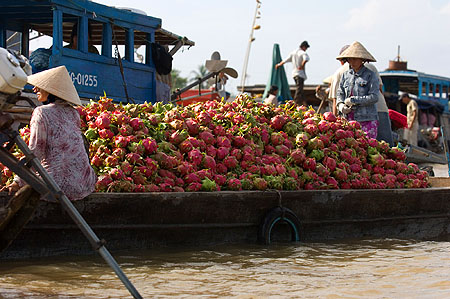
This past Friday, I found myself at our semi-annual Anthropology Symposium here on campus, where fellow Anthropology students have the opportunity to present both longer research papers and brief, innovative projects or proposals. One of my classmates, Mae, shared a portion of her thesis about the role of dragon fruit in Vietnam, where they are considered to be a staple item of both the local diet and culture, despite having originated in Central America. Through this presentation, I was most struck by her discussion of how this fruit that has become local, though foreign in origin,  has substantial political, economic, historical and symbolic value, all of which contribute to the identity of its Vietnamese consumers. I found Mae's presentation to exemplify the goal of this blog: to illustrate how food and the movements surrounding its production and consumption contribute to both individual and communal senses of identity.

According to Mae's presentation, not only is this precious dragon fruit representative of the contested relations between Vietnam and China, but it also represens both a point of commonality between the two neighboring nations and a symbol of authentic Vietnamese identity. This contradictory yet dually purposeful role of dragon fruit, as highlighted by Mae, is exemplified in grocery store observations, where the color of the inside of dragon fruits (Chinese red or Vietnamese white) is hotly debated and where customers reveal their trust in dragon fruit, for it is surely authentically Vietnamese and undoubtedly free of chemicals that may have been injected in foreign fruits. While Vietnam competes with China in the fruit market, the dragon fruit seems to contribute to the Vietnamese national identity by both straddling the border between these two countries and yet continuing to be labeled as securely Vietnamese.


These roles played by dragon fruit as a symbol of Vietnamese food values with political, economic, social and historical implications not only secure the fruit as a local food, as argued by Mae, but also seem to contribute to a national identity, further solidifying what is perceived to be Vietnamese, and what is not. Mae's presentation of her research reaffirmed in my mind just how crucial a role food can play in the formation and reinforcement of identity on both an individual level, for those grocery store customers reinforcing their nationalism by selecting a fruit they believe to be truly local and therefore safe, and on a national level, as the dragon fruit symbolizes the nation's past and present relations with neighboring China. After listening to Mae's presentation, it seems clearer to me than ever before that we truly are what we eat.


Friday, March 1, 2013

Buying the 'Local'


For the past few weeks, many of our class discussions have found their way back to the central topic of the strong contemporary desire to consume locally, as a means of pushing back against corporate agriculture and environmentally unfriendly consumption of products being imported or shipped across the country. We've spoken to representatives from our dining services here at Tufts and from a local farm, all of whom mentioned the importance of consciously seeking out local produce and facilitating the connection between producer and consumer as best as possible.

This morning, a certain television commercial caught my attention and invoked a sense of 'local' again in my mind, but from a different angle. This ad was sponsored by Miracle-Gro, showcasing its new "Groables" product. As the commercial states, these easy-to-use pods are perfect for those who are either too inexperienced or, to be frank, too lazy to grow plants the traditional way; they make planting as least labor-intensive as possible.

 So what does a product like this indicate about the current state of food activism? For starters, as mentioned in a previous post, the last decade or so has been dominated by a "back to the land" movement in which many consumers are trading in their canned or imported foods for fresh, local products, especially those whose labels read "organic." The decision and ability to consume locally becomes part of an individual's identity as someone demonstrating his/her personal awareness of choices made pertaining to food, accompanied by the joining of a growing (pun intended) community of self-proclaimed "foodies."

The epitome of consuming locally comes in the form of gardening, because it allows a consumer to be as close to the food to be consumed as physically possible. This sense of 'local,' accompanied by the desire to distance oneself from the capitalist corporations behind agribusiness, has unfortunately been captured by companies like Miracle-Gro. In transforming the idea of growing locally into an industry, evidenced by the sales of products like "Groables," major companies like Miracle-Gro are capitalizing on the desire of many Americans to identify with the consumption of local food. There are upscale "Grow Your Own" shops, expensive workshops focused on how to create a sustainable home garden, and dozens of highly-grossing gardening magazines that have turned the 'local' into a national industry. Ultimately, the corporate, capitalist-driven industry that has given way to disgruntled consumers seeking to go back to the land themselves has managed to exploit the very consumers seeking to avoid them at all costs.